
Experiencing my first Kiyoshi Kurosawa film on the big screen meant I had to travel to Edinburgh to the Cameo Picturehouse as the GFT wasn’t showing this one.
Cloud is the cut-throat world of capitalism personified – Bong Joon-Ho will definitely approve of this work. It doesn’t tread new ground with its statement so much as present it in the most contemporary manner using Kurosawa’s favourite evil: the internet. Perpetually miserable protagonist, Ryosuke Yoshii, is a reseller – or as I may refer to them – a scalper. He has a job at a factory, but he gets his financial kicks from buying in-demand products, counterfeit or otherwise, and reselling them online at an inflated price. It’s akin to gambling, and the film makes sure to show both the ups and downs of this practice. Even his relationship with his girlfriend seems to be entirely transactional. She cooks and attempts to make espressos for him, and in return she aims to use him as a source for material goods. He frequently appears to zone out of conversations too; seemingly showing the dehumanising effect of the modern cost of living.
After a big score and a few unsettling encounters, he moves to the countryside and attempts to expand his morally-dubious empire. A scene where Ryosuke convinces a shop owner to part with a batch of collector’s figurines is probably the most emotion he has shown so far, but it’s one of desperation rather than elation. The shop owner parts with the collection at double the retail value, drawing much ire from a waiting crowd outside. The number of enemies Ryosuke has is incalculable.
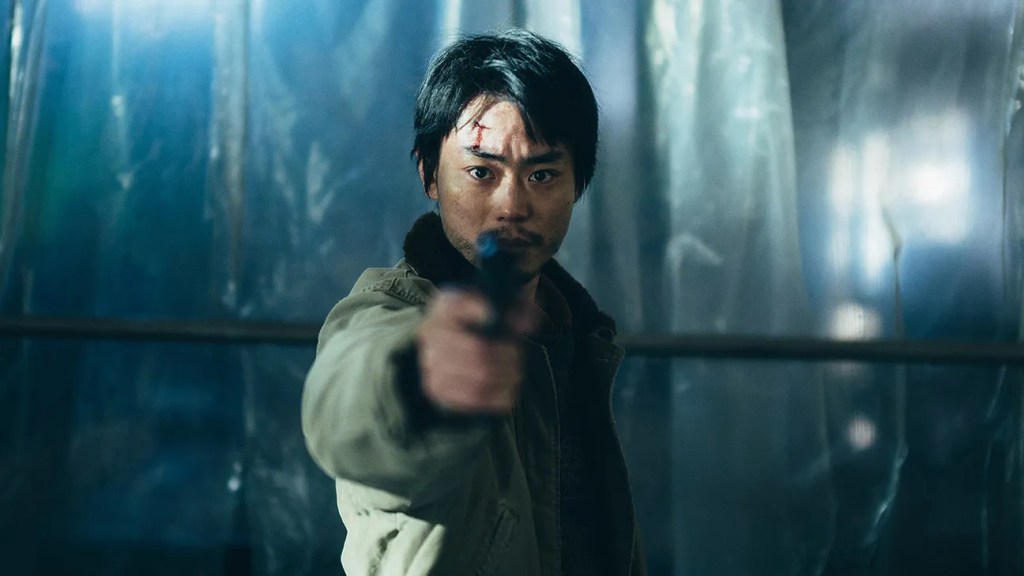
This is very much a film of two halves, as Kurosawa explores the world of online anonymity and the consequences of such personas resulting in real-world implications. A group of victims of his scams make it their mission to dox him and kidnap him, with the intention of killing him live on stream (a double bill of appropriate modern online paranoia). And for me, this is where it all falls a bit flat.
There’s a remarkable and admirable realism throughout the entire film, which makes the grounded-in-reality first half very engaging but an elaborate final shoot-out mostly quite dull. The absence of any kind of musical score is noticeable and thematically makes sense so that it doesn’t devolve entirely into a generic action flick, but it does contribute to the overall feeling of lack. There’s definitely a fantasy element to these proceedings, especially when Ryosuke is saved by a surprising hero, but also I think because of Japan’s very strict laws on gun control. Maybe that’s neither here nor there, but I can’t remember the last time I seen so many guns in a Japanese film. The shoot-out scenes play out at such a slow rate that I actually had time to write some of these notes and I knew I wouldn’t miss much film.
It’s a shame, because there’s still plenty to explore here. The kidnappers are only vaguely introduced as poor, broken men who almost have nothing to lose, which ties in with the intentional dehumanisation. There are brief glimpses at characterisation, but it mostly results in the archetypal role of incompetent hired goon. Ryosuke maintains an emotional distance from the competition, as he begins indiscriminately taking their lives to save his own. And upon doing so and making his escape outside, the first thing he checks is to see if his collectible figurines have sold.
For a similar but more satisfying in every perceivable way guy-out-of-his-depth-with-incredible-action-scenes kind of film, see Kim Jee-Woon’s A Bittersweet Life (2005) which got a (long overdue) 4K UHD and Bluray reprint earlier this year from Second Sight Films.
 Critical 24/60