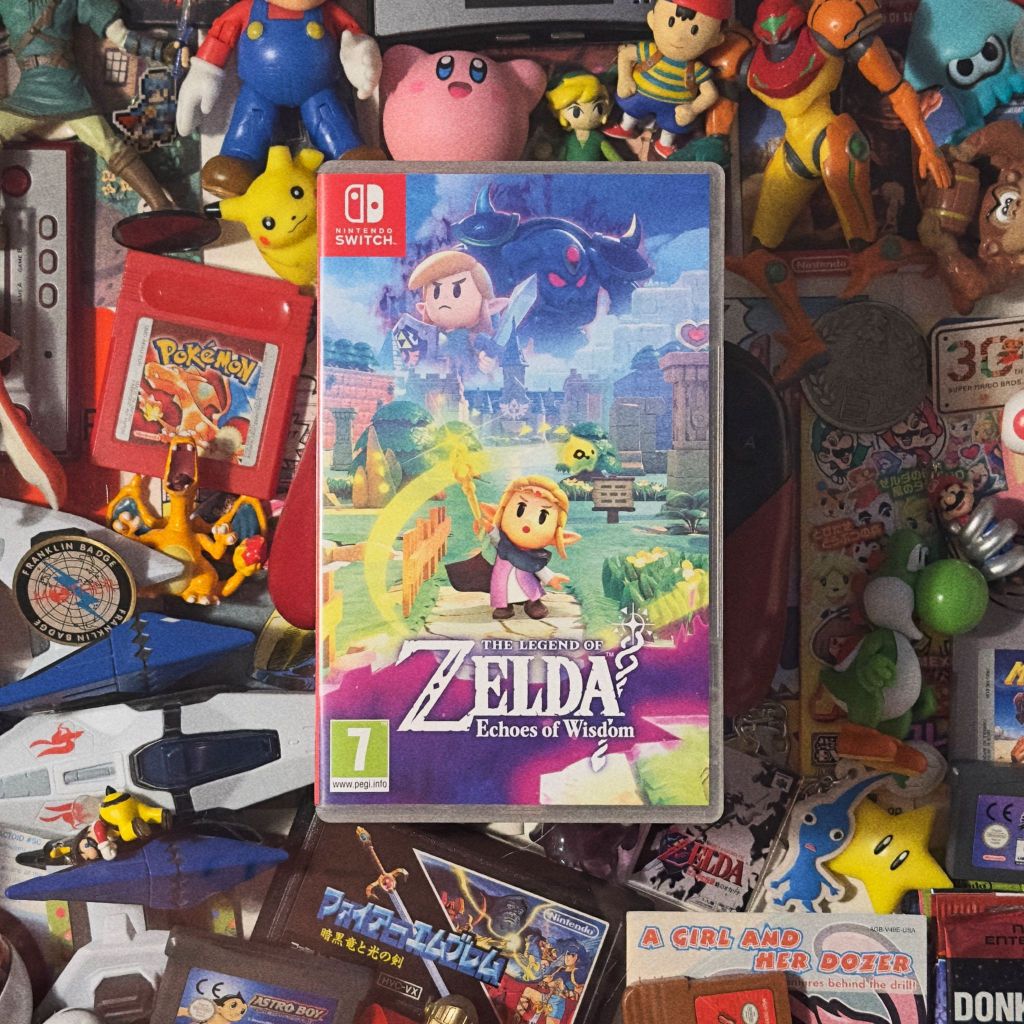

I was really looking forward to a new ‘classic’ Zelda game, but this Grezzo-developed effort plays it too safe while suffering from an identity crisis.
Echoes of Wisdom is the first game in the series (ignoring the CDi efforts from Philips in the 90’s) where you play as the eponymous princess, which is an enticing premise in its own right. But this identity crisis soon follows when, instead of giving Zelda a unique moveset that would challenge series conventions, the game grants her a power that lets her play… exactly like Link. The real Hero of Time is absent for the majority of the story, letting Zelda take centre stage, so it feels like a wasted opportunity that they couldn’t make her feel more unique. This is the first instance which feels like a wasted opportunity.
The game’s new and most innovative feature, the Echoes system, feels like a lite version of Tears of the Kingdom, with mixed results overall. Solving puzzles can mostly be done with the use of only a handful of Echoes, leaving many redundant. I was mostly using a combination of stacking the beds to create bridges, the water blocks to scale heights, the spider to create a climbable rope, and the flying tile to cross large gaps. Puzzle solving was interesting at first due to the limitations imposed, but it quickly became easy to find solutions later in the game. The combat, when not imitating Link, is achieved by summoning Echoes of enemies you have defeated and watching them fight. It’s frustratingly inaccurate and usually boring. Your echo uses the exact same pattern as the enemy which inspired them, meaning that they often avoid combat and use their attacks sparingly. This combat system can possibly be compared more to a real-time strategy, but you have more control over your units in Pikmin than you do in this game, for example.
The dungeons in these kinds of ‘traditional’ Zelda games have always been the real core challenge and they mostly stick to the expected high standard, though they also weren’t without issue. I had to look up a guide at one point because the game failed to explain how a particular mechanic involving a switch worked in my chosen route. Because I went to the Holy Lanayru Temple before the Faron Temple, I wasn’t shown how a particular switch worked when I came across it on my route. Both of the switches in these rooms are to be pressed at the same time, but there was absolutely no clear indication that that was the intention (and it’s not a puzzle I can recall from other top-down Zelda games either). I did feel quite stupid when I realised the solution, but felt better knowing that were users on Reddit and Gamefaqs that had the same problem as me.
One other aspect involving the dungeons requires mentioning, and that is the reward system. In true Zelda fashion, exploring the dungeons would eventually result in some kind of item or power up that would be used for solving problems and defeating the boss. This is mostly absent, instead, giving additional abilities that Zelda can use as Link. The most egregious example being when the Bombs of Might are gained in Elden Temple. Getting bombs at this point in the game felt especially pointless to me considering that the player will have already been through Zora River and will most likely have been utilising the Bombfish Echo for several hours by now. And when the game isn’t issuing near-pointless upgrades, most rewards for solving small puzzles usually consist of smoothie ingredients – another Breath of the Wild/Tears of the Kingdom-inspired addition. Smoothie ingredients are rarely in short supply, therefore opening treasure chests only to be rewarded with some chillies or milk is massively underwhelming.
The story isn’t very engaging either and is particularly uninspired. I wasn’t expecting a masterpiece of a narrative but, again with the idea of ‘safety’, the game feels like a greatest hits of well-known series locations and ideas. Zelda now adopts the role of silent protagonist in place of Link, leaving most of the dialogue up to newcomer, Tri, a spirit-thing that guides our heroine throughout the game. Aside from a few lines late in the game where Tri begins to somewhat understand human emotions, the dialogue is very dull and is simply used to progress the plot in the most basic fashion. And any time that Zelda and Link are on screen together, they communicate by exchanging a series of nods and glances with primitive animations.
I’ve come to expect a certain quality from first-party Nintendo titles, but Echoes of Wisdom suffers from near-constant frame drops, even when there’s not a whole lot on screen. At this stage in the Switch lifecycle, I find this somewhat baffling, especially since much more technically demanding games run optimally. Just like the Link’s Awakening remake before it, this is a very nice-looking game, with an art style resembling that of a miniature diorama. But, again like the Link’s Awakening remake, it’s quite unforgivable that this game suffers from some of the same performance issues as a game released 5 years prior.
This was my experience of the game. I have seen a lot more higher scores than mine, but there were just a few too many issues for me impacting my overall enjoyment. Despite all the negativity, a new Zelda title is always something to cherish and I did enjoy playing through it. But this will forever be a missed opportunity for Zelda’s first outing as the player-controlled character.
7/10
 Critical 24/60