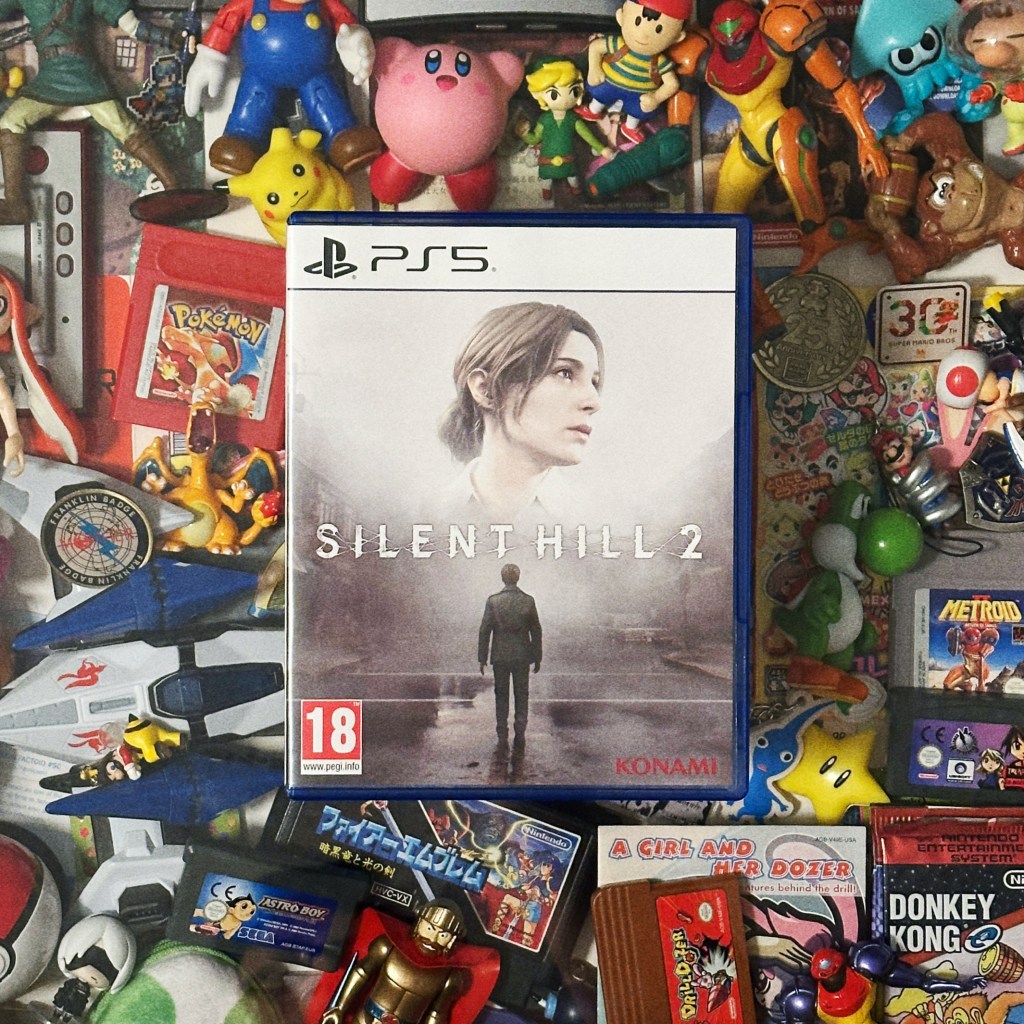

“You promised you’d take me there again someday…”
I cannot talk about the Silent Hill 2 remake without first talking about the game which it’s based on. The original Silent Hill 2 (2001) is essentially survival horror royalty at this stage. Search for any ‘best of’ horror games list and this title is guaranteed to be near the top for almost every single writer. I have to admit, however, I actually only completed the game for the first time around Halloween 2023.
I played it in the most “authentic” way possible – the original PS2 release, on original PS2 hardware, with a CRT TV – which I truly believe elevated my entire overall experience (I’m not a purist in this sense by any means, I just happened to have this setup available). A decades-old TV, featuring scan lines which compliment the grainy, foggy visuals and low-quality speakers which add a further distortion to Akira Yamaoka’s haunting score and sound effects. I also happened to be going through a breakup at the time, which, unintentionally, afforded me a heightened sense of sympathy for main character James Sunderland’s absurd journey of loss and pain. It’s one of gaming’s bleakest and most morally-ambiguous stories and was certainly one of a kind when it was released 23 years ago. Even now, there’s not many games I’ve played quite like it, so my playthrough in 2023 quickly became one of my favourite gaming experiences in recent memory. But, 23 years is a long time in this industry, so, looking at it from a contemporary perspective, let’s examine how successful Silent Hill 2 (2024) is at bringing this classic game to a modern landscape and how much of the original ‘essence’ remains.
The challenge I’m faced with is reviewing Silent Hill 2 (2024) from an entirely objective standpoint, considering the faint emotional investment I have in the original title. The developers, Bloober Team, had the hardest sell in my opinion: stick too close to the template of the original game and it’s an unnecessary remake, or stray too far away from that foundation and it loses its identity. If I had to choose, I’d say that it mostly plays it too safe, which is both a positive and a negative. For example, some cutscenes are often a shot-for-shot remake with exactly the same lines of dialogue, which I found to be quite disappointing. They’ve made minor changes that essentially ‘remix’ the events or the sequence of progression; a New Game+ for fans of the series. Before I get too focussed on the criticisms, however, I’ll discuss what I consider to be the positive aspects of the game.
Credit where it’s due, Bloober Team have absolutely delivered a successful, faithful and effective reimagining of one of the most beloved survival horror games of all time. It’s easily one of the best looking games I have ever seen. Familiar settings such as the Blue Creek Apartments, Brookhaven Hospital and Heaven’s Night are all present and have been respectfully recreated. The areas look fantastic and are incredibly detailed, while simultaneously being some of the most depressing locations you’ll find in any game. It’s difficult to imagine humans inhabiting any of these areas at all. Even in rooms with large windows, there’s a near-permanent darkness which is illuminated almost entirely with James’ less than adequate flashlight. The fog – which was initially used to mask hardware limitations – is just as effective as before and is an anxiety-inducing reminder that you can never feel safe or at peace. Like the persistent darkness, the fog encompasses a fear of the unknown and James’ metaphorical (and sometimes literal) descent. Toluca Prison is the standout location in terms of filling me with the ‘I don’t know if I can continue playing this’ kind of dread – It’s possibly the most aggressively grim location in any game I’ve ever played. It’s an oppressive, multi-level jail of rusted iron and damp walls crawling with Spider Mannquins, lit only by a timed spotlight that can be repeatedly activated by a breaker switch. My temporary reprieve from anxiety is timed, which actually increases my anxiety. By now, the developers know the player probably won’t like the dark, so this is a genius way of escalating tension within the user.
Part of what makes locations like Toluca Prison so effective is the use of audio, which is another Silent Hill and general horror game staple. The original game on PS2 used sound effects to trick the player into thinking there were monsters nearby, when there wasn’t. It would use crawling, scratching or groaning sounds to mess with the player psychologically in a way which almost breaks the Fourth Wall to instill a sense of fear, of a threat which never existed. I’m glad the remake has such a commitment to intelligent sound design and that it also succeeds in this aspect. Also, having Akira Yamaoka back to deliver a recreation of his soundtrack is one of the defining reasons why I chose to play this at all, in all honesty. The Silent Hill 2 (2001) soundtrack is so iconic that the composer and the game are inseparable for me. It’s a mix of heartbreaking ambience, terrifying noise/drone and occasional hard rock. I found some of the flourishes and additions to classic tracks to be a little distracting, but overall it does a fantastic job of complimenting the mood of the setting or tone of a scene.
So far the remake has nailed the feeling of what it means to experience Silent Hill 2 (2001), but it’s made some considerable changes to gameplay elements, and not all of them are successful for me. The biggest notable difference is with the camera and control scheme. Silent Hill 2 (2001) released 4 years before Resident Evil 4 (2005), a game which came along and revolutionised third-person gaming with its constant and immersive over-the-shoulder camera. Since then, the Resident Evil 2 Remake (2019) has been the recognised industry standard for not only how to modernise a classic game, but it’s also become the new benchmark for third-person survival horror games. Silent Hill 2 (2024) has followed the formula of Resident Evil 2 Remake too closely for my liking. The original game’s semi-fixed camera angles are gone in favour of the over-the-shoulder camera and, as a result, an effective story-telling tool and art form has been lost to time. The developers are in complete control of fixed-camera angles; they dictate what they want you to see and when, but, more importantly, they dictate what they don’t want you to see. These camera angles lent themselves well to survival horror, doubling down on the idea of the fear of the unknown and I think this is the first aspect in which the ‘essence’ of Silent Hill 2 (2001) is missing. It’s not only unfortunate from an artistic perspective, but from a technical perspective I experienced several issues where the camera either clipped through solid objects and walls or got so close to James due to the tight corridors that I had a hard time seeing the enemy directly in front of me. This happened far too often because the areas are so small and impacted my immersion every single time.
Speaking of combat and wearing its Resident Evil 2 Remake influences on its sleeve, combat is more of a focus in Silent Hill 2 (2024) than the original, which is also a negative change for me. Encounters with enemies are tense at first – they don’t have much knockback when you attack, so you can’t brute force your way through them without taking an inevitable hit. But when you start building up your small arsenal of guns, they quickly don’t possess anything resembling a challenge, especially when the game is fairly generous with ammo pickups. Healing items are also in abundance. I was taking regular hits when trying to brute force my way through with the melee weapons for the sheer hell of it and still had plenty of recovery items available. The enemies, while well designed and suitably horrible, are completely lacking in variety after a few hours. The tactics for defeating them remain the same in the first encounter as they do at the endgame. Having said that, the boss battles have drastically improved – particularly the one against Abstract Daddy, which is an impressively layered confrontation with trauma itself. In the original game, the boss fights were incredibly stiff and monotonous, so, if I’m forced more into more combat this time around, at least it’s better.
James is simply not an engaging protagonist. For someone exploring the depths of his psyche and facing physical manifestations of guilt, lust and a desire for punishment, James mostly appears as if he is largely unfazed by what he is experiencing. The most notable reaction we see from him at times is when he, without much hesitation, sticks his arm into a sickening toilet or an orifice in the wall. He (understandably so) has a reaction to being covered in shit up to his elbow, but seemingly has no issue with the gore and mayhem which he is responsible for. The original James Sunderland from 2001 was a vague, nondescript canvas as well, but there also seemed to be an otherworldly feel to his interactions with characters and the way he delivered dialogue. He seemed to be much more disconnected from reality than our grounded avatar in the remake, who gives the impression that this is all just a big inconvenience for him as he meanders his way through the town. He wants to convince himself and the other characters that he’s just a normal guy that’s here for the entirely normal reason of finding his dead wife who wrote to him. No big deal to him, apparently. As the player, I felt more terror than James ever did, particularly in the prison section, so it’s a shame it’s not reflected in his demeanour a bit more.
Lastly, I need to mention the core gameplay loop. After a while, it simply feels like we’re jumping from one area to the next, corridor after corridor, looking for keys, puzzle solutions or notes and dispatching enemies with little variety in between. There’s very little to interact with in the environments overall besides the aforementioned items. It can often feel like you’re just wandering through one impressively presented and well-dressed area to the next and it does become quite repetitive. I feel like there were more points of interest in the original version, where a button prompt would indicate what’s going through James’ mind when in certain locations or when faced with a particular grisly sight. Not only does the overall experience feel slightly ‘emptier’ in this regard, but I need to comment on the difference in game length, because it’s definitely been extended. There’s too much padding between significant and meaningful story beats, which often makes triggering a new cutscene not seem like much of a revelation or reward at all when they do occur. Perhaps it was partly because I knew what was coming, with occasionally the exact same dialogue as previously mentioned, or because I really just didn’t find many of the scenes to be as engaging this time around. Either way, the remake is a victim of both its own lofty ambitions and an industry which now demands games be longer and longer to justify the price tag.
With a combination of both the hardware I used and my personal circumstances in mind, Silent Hill 2 (2024) was never going to replicate that experience which made the original game so memorable for me. In terms of modern quality of life improvements and graphical lucidity, the remake earns plaudits from me for being the ‘optimal’ way to play James’ story. There are very few games where I would advise archaic technology, outdated game design philosophies and redundant control mechanics as the ideal way to play a video game. But Silent Hill 2 (2001) is, for me, still the best way to experience this tragic, nightmarish masterpiece.
8/10
 Critical 24/60